
BitStarz Casino Sister Sites
Most "sister site" lists are guesswork dressed up as research. Here is what actually makes two casinos related, and how to check it yourself in about two minutes.
Search for BitStarz Casino sister sites and you will find a dozen pages listing the same five or six brands, none of them citing a source. Most of those lists were built by looking at which casinos have a similar lobby, which is roughly as reliable as deciding two restaurants share an owner because they both use the same crockery supplier.
This page does something narrower and more useful: it explains what genuinely makes two casinos related, gives you a tool to check the licence yourself, and is honest about the limits of what anyone can verify from the outside.
What actually makes two casinos sister sites
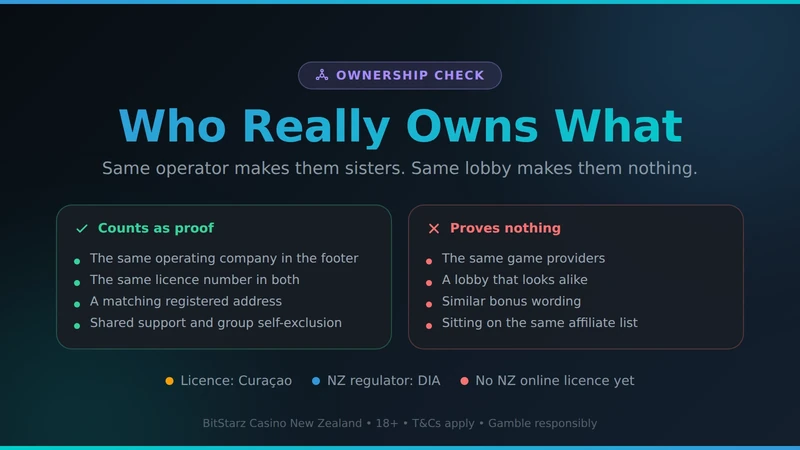
One thing, and only one: the same operating company. Everything else follows from that, and nothing else substitutes for it.
Evidence that counts
- Identical operating company named in the footer
- The same licence number in both footers
- The same registered address in the terms
- Shared support ticketing, or a support agent who can see both accounts
- A group-wide self-exclusion that closes both at once
Evidence that does not
- The same game providers — everyone uses the same ones
- A lobby that looks alike — that is the platform vendor
- Similar bonus wording — templates get reused industry-wide
- Similar domain names — anyone can buy a lookalike
- Appearing on the same affiliate's list, which is what most "research" amounts to
The reason the distinction matters is practical rather than academic. A shared operator means shared payout behaviour, shared verification standards and a shared complaints history. A shared game supplier means you will see the same slots. Only the first tells you anything about whether you will be paid.
Why New Zealand players go looking for alternatives
The account was closed or restricted. The most common reason, and the one where a sister site is the worst possible answer. If a group closed your account, its other brands will very likely close it too — often automatically, because the AML checks run against the same records. Ask for the reason in writing first.
The welcome bonus is already used. Fair enough, but read the terms before you assume a sister brand resets it. Many groups apply one welcome offer per household across every brand they own, and claiming twice is treated as abuse rather than as an honest mistake.
A payment method is missing. A reasonable motive, and one that often has a simpler fix. The payments page covers all ten rails BitStarz supports for New Zealand, including Account2Account, which people frequently miss because they were looking for POLi.
Payouts feel slow. Worth checking against the withdrawal times we measured before moving. In most slow-payout cases the delay is unfinished verification, not the operator — and that delay follows you to the next site.
Who operates BitStarz, and how to confirm it today
We are not going to print a company name here as settled fact, because operating entities in this industry restructure regularly and a page written months ago is a poor source for something you can check in thirty seconds. What is stable is the method:
- 1Open the casino and scroll to the very bottom of the homepage.
- 2Read the operating company name and the licence number printed there. That block is a licensing requirement, so it is the one piece of text on the site that has to be accurate.
- 3Search that company name in the regulator's register linked below. Anything else it returns is a genuine sister brand.
- 4Repeat for any casino someone has told you is related. If the company names differ, they are not sisters, whatever the list said.
Two caveats worth stating plainly. Licence numbers move — Curaçao's transition from the old master and sub-licence system to direct licences reissued a great many of them, so a changed number is usually administrative rather than sinister. And group membership shifts: the only claim you can rely on is the company name printed in the footer today.
Licence checker
Pick a brand to see who operates it and where it is licensed, then verify the answer yourself in the register linked underneath. This widget is a starting point; the footer of the casino is the source of truth.
Operator
—
Licensed in
—
Related to BitStarz?
—
Verify it in a register
- Curaçao Gaming Authority — the licences most crypto-era casinos actually hold. Curaçao replaced the old Antillephone master and sub-licence structure with direct CGA licences, so a footer number that has changed since you last looked is normally a reissue.
- MGA licensee verification — searchable list of every brand operating under a Malta licence.
- Department of Internal Affairs — the New Zealand regulator. As at the date this page was last checked, no offshore online casino holds a New Zealand licence, because the licensing regime created by the Online Casino Gambling Act 2026 is still being stood up. Any site claiming an existing NZ online casino licence number is misrepresenting itself.
Same platform, different operator
This is where nearly every incorrect sister-site claim comes from. A handful of white-label platform providers power hundreds of casinos. They supply the lobby, the cashier layout, the bonus engine and often the support software. Two casinos built on the same platform will feel almost identical to use — same menu structure, same filter chips, same withdrawal form — while being owned by companies with no connection at all.
What that similarity does not transfer is anything you care about: payout policy, verification strictness, complaint handling, or whether a large win gets paid without an argument. Those are operator decisions. Judging a casino by its lobby is like judging a bank by the brand of its ATMs.
What the New Zealand licensing shift means for group-hopping
Until recently, the question of which offshore group a casino belonged to was mostly about reputation, because none of them were licensed here and none of them could be. That is changing. The Online Casino Gambling Act 2026 created a domestic online casino licensing regime administered by the Department of Internal Affairs, with a capped number of licences allocated through a competitive process.
The practical effect for a New Zealand player is that the industry is about to split into two groups: operators that hold a New Zealand licence and are accountable to a regulator you can actually complain to, and operators that do not. Which side a brand ends up on is decided at operator level, which means it applies to every site in a group at once — and that is the first time sister-site membership will have had a concrete, checkable consequence for New Zealand players.
Worth knowing: playing at an offshore casino has not been an offence for a New Zealand player under the Gambling Act 2003, and the new regime is aimed at operators rather than at players. What changes is where you can turn if something goes wrong. Dates and detail on this are moving; check the DIA site rather than a page like this one for anything you plan to act on, and treat the timeline in any affiliate article — including ours — as a snapshot of when it was written.
When switching to a sister site is the wrong move
- You were closed for a verification or AML reason. The same checks run at every brand in the group. A new signup will usually fail the same way, and now it also looks like an attempt to get around a closure.
- You self-excluded. Group-wide exclusion exists on purpose and is the one part of this industry designed to protect you. Working around it is the single clearest sign that the break was needed.
- You are chasing a second welcome bonus. One offer per household across the group is the norm. The usual outcome is voided winnings after you have already played through the wagering.
- You have a payout in progress. Finish it. Opening a second account mid-withdrawal is the fastest way to have both accounts frozen while someone works out what you are doing.